
Stellar Lab Radio Episode2 Guest:Yo Mabuchi
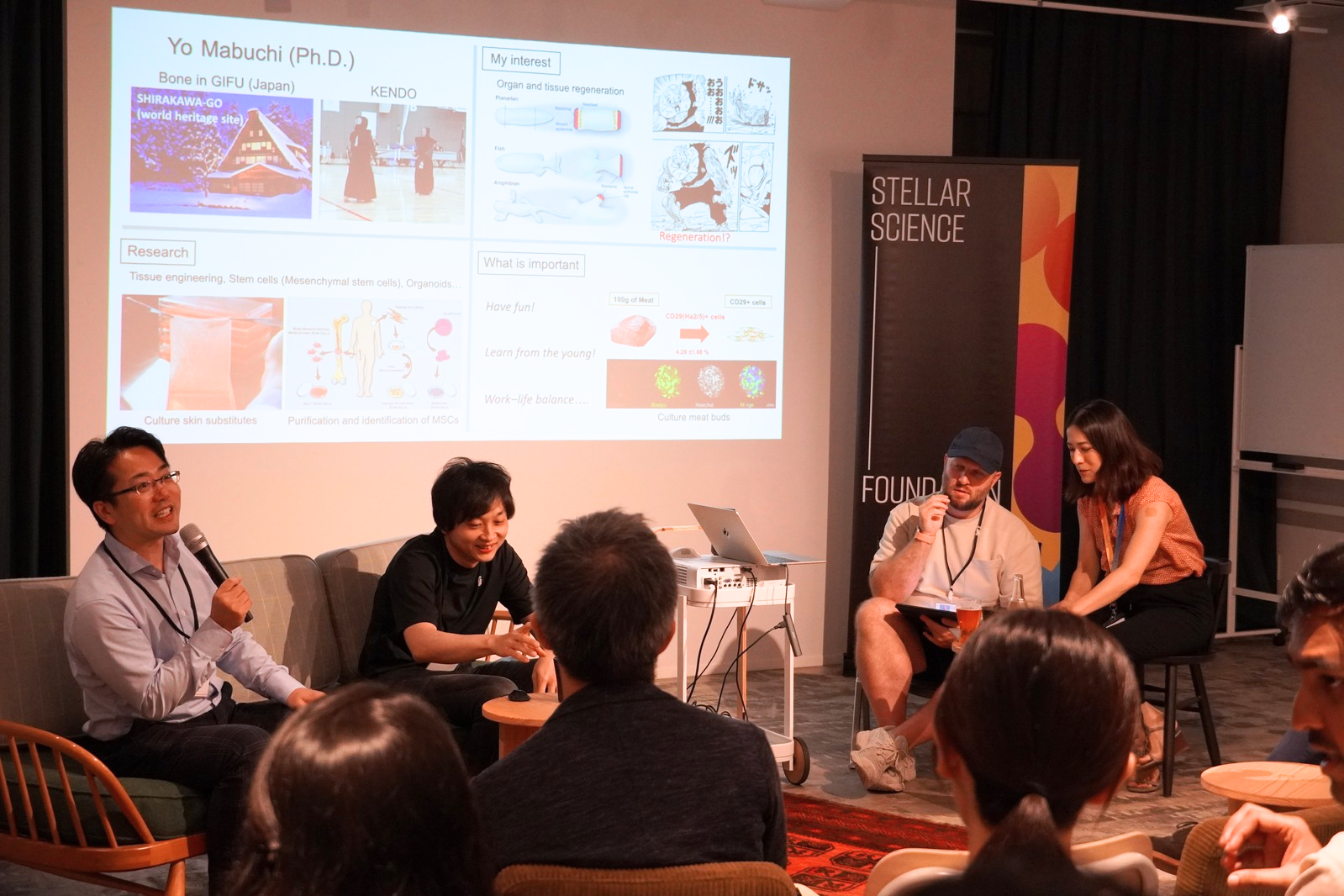
Inside the body lie mesenchymal stem cells. Research that unravels their power extends far beyond wound healing, reaching into unexpected future possibilities such as the development of cultured meat and even cell cultivation in space. In this episode of Stellar Lab Radio, we welcome Yo Mabuchi, Associate Professor at Fujita Health University, who is working at the very forefront of this field.
Stellar Lab Radio is a talk program that shines a light on “world-changing research that no one yet knows about.” Leading researchers active on the global stage share their cutting-edge science, the stories behind their breakthroughs, and their visions for the future.
In the first part, we explored the foundations of stem cell research: from the surprising stress resistance of cells, to the potential of organoid technology in creating “cultured meat.” We discussed how research connects with broader social challenges, and the vast possibilities it opens up.
In this second part, under the theme “Bringing new options to medical treatments,” we dive into what the future of medicine could look like through cell therapy, while also uncovering Professor Mabuchi’s origins and perspectives as a researcher. From the unexpected inspiration of crocodile leather bags, to the evolving role of scientists today, and even the secrets to a stress-resilient research life—this episode offers a rich conversation where science and life intersect.
A New Option for Treatment
Sean:
There’s one more thing I really wanted to ask you, Professor Mabuchi. Your current research on mesenchymal stem cells and organoids—of course, I imagine it connects to medicine and pharmaceuticals. But I’d love to hear what kinds of applications you envision.
Mabuchi:
Well, I don’t think my technology will suddenly make incurable diseases immediately curable. But what cell therapy can do is provide a new treatment option—an additional path alongside the therapies that already exist. That’s how I see this technology.
Sean:
I see.
Mabuchi:
Because even if we talk about one disease, when you look closely, there are many subtypes. Under the same diagnosis, one patient may respond to a particular drug, while another may not.
When the drug works, that’s great. But when it doesn’t, patients are often left with no choice but to rely on their body’s natural healing power.
In those cases, many people end up trying all sorts of things—taking unproven remedies, trying questionable medications, soaking in hot springs—without knowing if any of it will really help.
But if there is a scientifically validated, evidence-based cell therapy, then maybe that treatment could work remarkably well. In that sense, it can provide patients who are searching for answers with a new, reliable option.
Sean:
For people who are ill, knowing how many options they have—and whether those options fit their body or their lifestyle—is crucial. The fact that a therapy is research-backed and scientifically proven makes all the difference.
Having that additional option can empower patients to decide whether they want to aim for a cure, or find a way to live alongside their condition. I think developing more of those options is truly for the benefit of patients.
Mabuchi:
Exactly. With a pill, it’s simple—you can take it every day. But you can’t undergo surgery every week.
Sean:
Right.
Mabuchi:
In cases like that, just one treatment might be enough. Stem cells can stay in the body and continuously release beneficial substances.
It’s like when your leg hurts and you put on a pain-relief patch—then it hurts again and you put on another patch. That only addresses the symptom, not the underlying problem. But if stem cells could actually repair the root cause, then patients’ quality of life—their happiness—would improve over the long term.
So, unlike conventional “one-shot” drugs, cell therapy may offer an entirely new kind of sustained effect.
The Future of Medicine Begins with Patients “Knowing”
Sean:
Cell therapy and regenerative medicine clearly hold tremendous potential, but I feel they’re not yet widely adopted. There may be many reasons—whether research-related or tied to how medicine is practiced. From your perspective, Professor Mabuchi, what would make cell therapy more common? What would help it spread further?
Mabuchi:
That’s a very important question. I believe one key foundation for advancing regenerative medicine is that patients themselves take more interest in their treatments.
For me, I’ve been thinking about illness and how to cure it for ten or twenty years, so naturally knowledge accumulates over time. But when someone suddenly becomes ill, their first thoughts are simply: I need to get better, and quickly—what should I do?
They don’t necessarily stop to ask: Is this a disease that can be cured, or one that’s difficult to treat? What treatment options exist? Instead, they tend to just follow whatever their doctor tells them, without carefully considering alternatives.
But in reality, there’s a wealth of information out there—websites, resources, medical literature. If patients take the time to learn about their condition and actively seek out treatments for themselves, they can make better choices when it comes to regenerative medicine and new therapies.
That process of patients gaining knowledge and taking initiative is, I think, essential for the wider adoption of these therapies.
Sean:
That makes sense. When people are sick, fear and confusion often take over, and it’s easy to just do whatever the doctor says without fully understanding. But if, at that moment, they could learn about their condition and the available treatments—including the option of cell or regenerative therapy—then it would be much easier for patients to choose what’s best for them. And creating that kind of environment might accelerate adoption.
Mabuchi:
Exactly. And another point is that regenerative medicine is often still seen as something only researchers are working on—but actually, that stage is already over. Now, many companies are heavily involved.
At universities, we make discoveries and show what might be possible. But turning those discoveries into real products requires a long journey and tremendous resources. For that, you need not only academic researchers but also corporate researchers, industry specialists who can develop products, and even legal experts to build the necessary regulations.
It takes all of these people working together as one. Without that collaboration, it’s very difficult for regenerative medicine to become widespread.
The good news is that Japan is currently investing heavily, with strong national support to push this field forward. So I truly hope the public will also take interest and support these efforts.
A Crocodile Leather Bag as the Gateway to Cell Therapy?
Sean:
Listening to your many research stories, Professor Mabuchi, I find them fascinating—not just the science itself, but also the way you balance deep understanding with solving social issues.
It made me wonder about something more fundamental: why did you become a researcher in the first place?
Mabuchi:
That’s a good question… why was it, I wonder?
When I was little and we had to write down what we wanted to be, I actually wrote “train pilot.” (Though of course, trains don’t have pilots! laughs) I meant I wanted to be a train driver.
So, being a researcher wasn’t really my childhood dream. But as I went down the science track, doing experiments and research, I realized how interesting it was. That might have been the first spark.
One of the unique things about researchers is that their curiosity itself becomes their work. That means the job stays enjoyable, because it’s directly linked to what interests you. Even on weekends, I’d find myself still thinking about research—but it never felt like a burden. That was definitely part of the appeal.
When I started my master’s program, there was a lab at the university that grew artificial skin in flasks. Most people would think, Wow, this could help with medical treatments.
But I thought, If we can make crocodile skin, I could mass-produce crocodile leather bags and get rich! laughs If you can grow human skin, then why not crocodile skin?
I figured, This could be my big break! So I went straight to the professor that same day and said, “I want to work on artificial skin.”
He asked me, “What kind of disease do you want to use it for?” And I said, “I don’t know about diseases, but I’d like to use it to make crocodile bags.” He told me that might be a little difficult. laughs
Still, he let me join. That lab specialized in the dermis rather than the epidermis, and he said, “We don’t really make epidermis here.” But I insisted I wanted to work on dermis too.
That’s how I first stepped into the world of cell therapy.
Sean:
That’s a great story. So… do you own a crocodile bag now?
Mabuchi:
No, I don’t. laughs
But I think I do have that entrepreneurial side of me, that tendency to think, Maybe this could make money. I don’t like to admit it, but it’s true. Cultured meat was the same—part of me thought, This could actually be profitable.
Sean:
You thought it might be a money-maker?
Mabuchi:
Exactly. It’s not the most noble motivation for a researcher, I know. But I tend to be drawn to things that surprise people or make them think, I’d love to have that. That curiosity has been one of the key drivers for me.
“Losing Track of Time” — Why Research Became My True Calling
Sean:
That’s really interesting.
When you were young, you wanted to be a pilot or a train driver. But the more you pursued science, the more you realized how fascinating research could be. And then you also had that sense of, this could even be profitable. That balance is really intriguing.
It makes me think—that’s such a classic “science person” mindset. laughs I’d love to know: why did you choose science in the first place? Was it something you were always drawn to from a young age?
Mabuchi:
I think a lot of it came from my parents.
My father was a veterinarian and worked at a public health center, but he also did research. On weekends, he would take me to places with animals, and we’d play there.
I’d play hide-and-seek in a room that literally had cow brains preserved in formalin, or I’d feed animals—that kind of environment was normal for me. There were always animals and researchers around.
Looking back, that definitely shaped me, though at the time it just felt like everyday life—like, this is my dad’s workplace, this is what he does.
We even had a microscope at home. I would use it freely to look at things, and that was probably when the path toward science started narrowing without me realizing it.
Sean:
I see. That’s amazing—I’m a little jealous, actually.
In the U.S., there’s this saying that the ideal job is one where you never feel like you’re working. People dream of being able to say, I’ve never worked a day in my life.
The fact that you could spend weekends thinking about research without it feeling like a burden—that you found that passion so young and grew up in an environment where it was normal—that makes for such a great story. You found something you truly loved. I think that’s wonderful.
Mabuchi:
When you put it that way, it does sound cool. But there’s another reason too.
Until recently, I’ve always had a really poor sense of time. I was late for everything, constantly missing appointments—I think something in me was just missing. Maybe it was because I was raised in such a relaxed environment, but even my parents used to say, “You’ll never survive as a working adult.”
The thing is, research allows for a more flexible sense of time. Now I realize that, but back then, I thought: If I don’t find work like this, I won’t be able to survive.
In jobs where you have to arrive at a set hour, report everything at specific times, and follow strict schedules—I don’t think I could have done it. So naturally, the option that remained was research.
Sean:
But I don’t think that’s a bad thing at all. Not everyone is meant to live by rigid schedules. In fact, that freedom is what makes researchers so creative. Having fewer restrictions allows you to shine in ways that others can’t. That’s amazing.
Mabuchi:
Thank you.
The truth is, once something captures my interest, I can keep at it endlessly. That used to make things tough for my parents.
For example, during my brother’s elementary school sports day, I went missing. They looked for me for hours, worried sick—only to find me happily playing alone in the sandbox the whole time. I must have gotten completely absorbed, thinking, This sandbox is amazing! laughs
The adults were panicking, but I was just sitting there, totally content, oblivious to everything else.
The Changing Role of Researchers
Sean:
That’s really interesting.
But honestly, I imagine you must be very popular in your current lab, Professor Mabuchi. You’re good at interacting with people, and I feel like you’re the type who values others.
Mabuchi:
Hearing that from you, Sean, really makes me happy. laughs
But no, as a researcher—especially as a PI—you need many different skills to build and manage a lab. I’m still in the learning phase on that front.
I was talking with Professor Takebe recently about this: freedom and flexibility are important, but being too soft or laissez-faire doesn’t always lead to the best outcomes when you’re trying to organize a group. Sometimes you do need to speak up firmly, and in order to bring out people’s full potential, you might need to give them a proper mission—or even apply a certain level of pressure.
Not “power harassment,” of course, but the right balance of challenge and responsibility can actually raise creativity. With today’s compliance standards, it’s all about finding that balance. That’s something I’m still studying.
Sean:
Right. And even when you’re running a lab, it’s not like working in a big company, where one department handles one thing, another department handles something else, and so on. In a lab, you’re responsible for everything—deciding what research to pursue, securing funding, shaping the atmosphere, managing operations, training junior members.
It’s like running a small company or startup where you’re in charge of it all. That’s a really high hurdle.
So as a researcher, it’s not only about discoveries—like your work on mesenchymal stem cells—but also about running a lab that can consistently produce breakthroughs. That seems incredibly challenging.
Mabuchi:
Yes, that’s something I only realized after becoming a researcher myself.
In my generation, the stereotype of a researcher was someone completely absorbed in their work, socially awkward, always wearing a lab coat, and not communicating with others. But as you know, Sean, that image has changed dramatically.
Nowadays, researchers need to gather information from many people, actively reach out, and communicate their work to the world. The role of the researcher itself has evolved.
Becoming a PI means learning to truly communicate, manage, and develop a wide range of skills beyond just doing experiments. That’s a big shift.
The Keys to a Stress-Free Research Life: Objectivity and “Thick Skin”
Sean:
For example, with the members you work with now, or those you direct—if they were talking about you when you weren’t there, what would you most like to hear them say? What comment would make you happiest?
Mabuchi:
Ah, you mean how I’d like to be perceived.
Sean:
Yes.
Mabuchi:
When I’m teaching, say I have three students, I often tell them not to worry about the others’ progress. Focus only on your own work.
In other words, cut out unnecessary information. Don’t compare yourself to others.
Because if I’m dangling a carrot in front of one student, but they also see the carrot next to them, they’ll start thinking, That carrot looks better—there are two over there! Then they lose balance.
So I tell them: Others are others, you are you. I apply the same mindset to myself, too. Even if I sometimes catch myself wondering what my peers are doing, I remind myself to refocus on my own path.
That way, I don’t worry too much about what others think of me. And not worrying is, in fact, very stress-free.
For example, if I’m working in the lab until midnight, but another researcher leaves at 5 p.m., it doesn’t bother me. Maybe they’ve finished their work. I enjoy doing research, so I don’t feel resentful. If someone else gets good results or goes home early—good for them. I try not to feel it’s unfair.
Thinking like that makes me realize I probably couldn’t survive in a regular company. laughs I only really care about my own work.
Sean:
That’s interesting. But do you consciously try not to think that way, or is it just natural for you?
Mabuchi:
I think it’s natural—I usually don’t feel that way. Though people do sometimes tell me, “Pay more attention to what’s going on around you.” laughs
Sean:
I see. Well, that can be both a strength and a weakness. Comparing yourself to others can sometimes bring jealousy or resentment, but it can also spark inspiration.
In your case, instead of comparing yourself to others, you immerse yourself deeply in your own research. That makes me wonder: do you even have days where you feel down or unmotivated?
Mabuchi:
I do.
Sean:
You do?
Mabuchi:
Yes, definitely.
But when it happens, I sometimes catch myself thinking, Wow, I’m really down right now—that’s kind of interesting.
It’s like realizing, Huh, so I actually do care about that, don’t I?
Sometimes I don’t even notice I’m depressed until I suddenly realize while walking: Wait, aren’t you really down right now?
Sean:
That’s fascinating.
Mabuchi:
Yeah. And sometimes I’ll even forget why I’m down. Later I’ll think: Hold on, I’m feeling low… but why? Then it clicks: Oh right, it was because that experiment didn’t work out. laughs
So maybe something in me is missing. But that’s how it goes.
Sean:
That’s really interesting. At Stellar Science Foundation, we often say “Stellar” is about shining a light on world-changing research that’s not yet known.
And I may be interpreting this too freely, but after hearing you today, I feel like you yourself are stellar. Because of your resilience, your ability to stay stress-free, and also your objectivity—the way you can step back and observe yourself. Would you agree?
Mabuchi:
Yes, absolutely. That means a lot—thank you.
The word “stellar” has that sense of shining, of radiating outward. To me, it suggests the unique power an individual researcher has, and the way that power influences those around them. I hope the Foundation will continue to gather and nurture such researchers.
Sean:
But I still wonder—how do we actually find and cultivate more people like you?
Mabuchi:
laughs Well, in my case, I survived largely because of stress tolerance. Others might thrive because they’re highly skilled and move forward decisively. There are many different patterns.
That’s what makes researchers interesting—you can’t replicate one person’s path and expect the same results.
That’s also what makes nurturing researchers both difficult and fascinating.
Even at 80, I’ll Still Be Chasing My “Current Obsession”
Sean:
I have one more question—it might sound a little teasing.
Mabuchi:
Go ahead, I was wondering when that would come up. laughs You’ve been so serious so far, I kept waiting for the moment you’d pull the rug out from under me.
Sean:
Well, what I’ve noticed is that you really love research. You dive straight into whatever sparks your curiosity, and you don’t seem too concerned about what others think. It doesn’t even look like work—it’s more like you’re enjoying a hobby or following your own interests.
So here’s my question: when you’re 70 or 80 years old, what do you think you’ll be doing? I don’t really see you “retiring” in the conventional sense. Have you ever thought about that?
Mabuchi:
Yes, I have. And I think I’ll always be chasing whatever my current obsession is.
Sean:
That makes total sense.
Mabuchi:
Right now, it’s mesenchymal stem cells. Of course, that kind of research needs a lab and a certain amount of funding.
But aside from that, there are so many things I’m curious about—like, why are trees green? I’ll probably always have questions like that.
So even if I’m not doing lab research anymore, I think I’ll still be exploring science in other ways, reading, thinking, and following my curiosity.
Learning from Other Fields, Expanding My Own Research
Sean:
There’s one more thing I wanted to ask. Recently, is there any research you’ve come across that you found especially fascinating—something you’d call “stellar research”? It could be in any field.
Mabuchi:
Oh yes, definitely.
There’s actually a researcher I’ve been following for a long time, who also happens to be a senior from my high school. He attaches GPS trackers to penguins to study their movements.
That field is called bio-logging. By tracking how penguins—or migratory birds, or even whales—move, you can uncover worlds we humans normally can’t see.
He even published books, and I think he was featured on a TV documentary series in Japan. I found it so fascinating that I bought his book right away.
For example, have you ever wondered how whales sleep? Nobody really knows. But by attaching GPS devices and monitoring them, they discovered whales actually sleep vertically—with their heads pointing up. Why, we don’t really know. But when they sleep, they remain upright and still.
Or with penguins—you find that after diving, they come back up much quicker than expected. You can even study how they move around and raise their chicks—all through GPS data.
That got me thinking: What if we could attach GPS to mesenchymal stem cells after injecting them, to see where they travel in the body? That kind of idea inspires me.
Another example: there’s a field called “imaging science” where you send waves into an object, and by calculating the distortions in the returning signals, you can reconstruct its shape. It’s being applied to things like detecting cancer.
But one scientist said it could even be used from space—like beaming waves down on Japan to search for buried treasure, maybe even Tokugawa’s legendary hidden gold! It sounds crazy, but in theory, you could detect anomalies that way.
And of course, my mind went: If I shine waves onto injected mesenchymal stem cells, maybe I could see how well they’re engrafted. Everything I encounter somehow circles back to my own field. laughs
That’s what makes it exciting—when you combine interesting technologies with your own, it multiplies the possibilities.
So I think having curiosity about research outside my field—and exploring how it could intersect with my own—is one of the most rewarding “hobbies” I have.
Sean:
That’s fascinating. And I imagine you sometimes use that inspiration directly, trying new things in your own research. At the same time, since you don’t really compare yourself to others, I wonder: do you ever think, I want to be like this person or I want to be able to do what they do? Or looking ahead—say in ten years—do you have an image of the kind of researcher you want to become?
Mabuchi:
Good question. Maybe it’s less about being a certain type of researcher, and more about being a certain type of person.
Often, the seeds of interesting research come from casual conversations—with friends over drinks or tea. I’ll ask, “Heard of any exciting research lately?” and get inspired. Then I’ll go look it up, interpret it myself, and learn from it.
Because I enjoy that so much, I also love sharing discoveries in return.
So ideally, I’d like to be the kind of researcher where people say, “Whenever I talk to Mabuchi, I hear something exciting.”
Even if it’s just meeting up for a meal and saying, “By the way, here’s some cool research I came across recently,” and sparking curiosity—that’s the kind of role I’d love to have.
Sean:
That’s wonderful. Honestly, I feel like you’ve already achieved that. Every time I talk with you, I feel a sense of excitement and wonder. And before you know it, time has flown by.
So I hope we can talk again soon—and that you’ll share more of those exciting stories with us.
Mabuchi:
Of course. I’ll make sure to prepare something new for next time—something fresh to share.
