
On January 25, 2026, the Stellar Science Foundation (SS-F) convened approximately 30 researchers at a venue overlooking Osaka Castle to envision and discuss the science of the future.
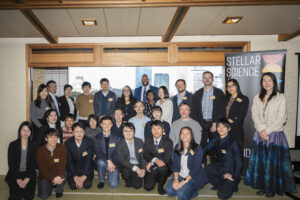
This event was part of the “Pioneers Series,” a seminar series organized by STELLAR SCIENCE FOUNDATION (SS-F), launched in July 2025 to welcome world-renowned researchers as guest speakers to share insights on breakthrough science and career development, while also fostering networking opportunities among early-career researchers who will lead the next generation of science.
For this special edition, titled “Pioneers Series Special: The Science of the Future,” six world-leading researchers in the fields of regenerative medicine, developmental biology, and human evolution were invited as panelists for two uniquely interactive discussions along with a Japanese cultural experience session.
Uniting Expertise to Advance Stem Cell Technologies into Practice
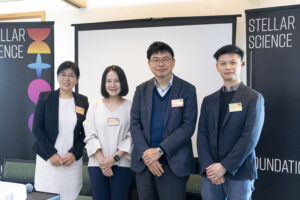
Following an icebreaker in which each participant briefly introduced themselves, the program moved to the first panel discussion. Under the theme “Human Biology of the Future: The Next Frontiers in Disease Modeling and Regenerative Medicine,” Dr. Hideyuki Okano (Keio University), Dr. Shuibing Chen (Weill Cornell Medical College), and Dr. Mingxia Gu (University of California, Los Angeles) took the stage as speakers.
This year marks the 20th anniversary of Dr. Shinya Yamanaka (Kyoto University) first reporting the development of induced pluripotent stem (iPS) cells. iPS cells can be generated from somatic cells, such as blood or skin cells, and can differentiate into almost any cell type in the body. Leveraging these properties, researchers worldwide are advancing studies that use patient-derived iPS cells to construct disease models, elucidate disease mechanisms, and identify potential drug candidates. At the same time, extensive efforts are underway to realize regenerative medicine by generating new cells and tissues from iPS cells and transplanting them into patients to replace those that are dysfunctional or lost.
Over the past two decades, iPS cell technology has driven extraordinary progress in biomedical science, fundamentally transforming disease research, drug discovery, and regenerative medicine. As the field marks this milestone anniversary, leading stem cell researchers from around the world are visiting Japan this year, creating a timely and exceptional opportunity to convene global experts and engage in discussions on the future direction of stem cell science.
Dr.Okano introduced his team’s work in identifying a candidate drug for amyotrophic lateral sclerosis (ALS) using disease-specific neuronal models derived from patient-derived iPS cells, a project that has progressed to clinical trials. Drawing on this experience, he noted the growing interest in iPS cell-derived disease models as a means of reducing reliance on animal experiments.
The panelists discussed the next frontiers in disease modeling and regenerative medicine, including underexplored areas. Dr.Chen highlighted both the seminal advances in organoid models of disease derived from iPSCs and the challenge of constructing a single, integrated disease model that incorporates multiple organs. Dr.Okano further noted that, for certain diseases, distinguishing between diseased and control states can itself be difficult. Additional perspectives from the floor underscored the importance of research focusing on cell morphology, mitochondria, protein-level analyses, as well as evolutionary processes that have shaped what makes us human.
One of the major promises of translating iPS cell technologies into practice lies in precision medicine. Rather than applying uniform treatments to all patients with the same disease, precision medicine aims to deliver optimized diagnostics and therapies tailored to individual patient characteristics and disease profiles. A key element discussed in advancing precision medicine was data sharing. Even in iPS cell generation, for example, source cell types and methodologies vary. Broader access to sequencing and related datasets could enable cross-institutional and cross-national comparisons, yielding new insights and supporting standardization. However, external access to such data is often limited. Participants therefore expressed hope that the International Society for Stem Cell Research (ISSCR) would take a leadership role in advancing discussions, education, and certification frameworks to facilitate broader data access.
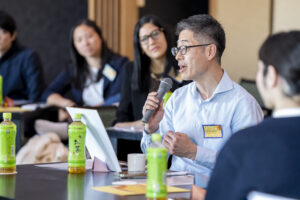
Furthermore, Dr.Gu pointed out the high cost as a practical barrier to the realization of precision medicine. The production of iPS cells and differentiated cells remains costly, and even if these approaches were to become feasible, they would still be prohibitively expensive and difficult for individual patients to access under current conditions. She further noted that the use of artificial intelligence (AI) and robotics could help reduce costs through process standardization and related efficiencies.
Beyond standardization and the resulting potential for large-scale production, ongoing technological advances are expanding the range of methods and tools that can be applied to stem cell research. Bringing together the broad spectrum of expertise that underpins these advances—spanning mathematics, physics, biochemistry, and related fields—through interdisciplinary collaboration may be key to overcoming these challenges. As Dr.Chen noted, there is also much to learn from historical examples of successful technology translation.
Expressing Aspirations Through Calligraphy
Research is a creative endeavor in which new knowledge is woven into the foundations laid by those who came before us. To offer participants a different form of creativity from their everyday work, while also fostering deeper connections through an engagement with Japanese culture, SS-F organized a calligraphy cultural experience.
Serving as the participants’ instructor was Ms. Ginsho Murakami, one of Japan’s leading calligraphers. A recipient of the Prime Minister’s Award in 1983, she has also devoted many years to calligraphy education. Driven by a desire to share the joy of calligraphy with people from around the world, she continues to engage actively in teaching today.
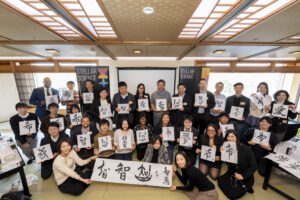
In the cultural experience session, participants selected one character representing their mentality on the science of the future—“Hope (希),” “Dream (夢),” or “Knowledge (智)”—to write on traditional shikishi paper. Ms. Murakami first demonstrated exemplary brushwork while explaining the meanings of each character, its evolution through time, and stylistic features. Her powerful yet fluid strokes captivated the audience.
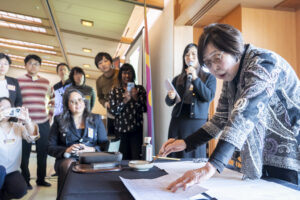
Participants then began their own work, carefully forming each stroke while receiving support from Japanese researchers. The room was filled with a unique blend of quiet concentration and excitement.
 One participant from the United States chose the character “Knowledge (智),” explaining that it reflected his motto of strength and perseverance in academia. “I might just have to go back to Tokyo and find a calligraphy class and get a new hobby under me,” he shared excitedly after holding a calligraphy brush for the first time.
For many international participants, it was their first experience with calligraphy, while for Japanese researchers, it evoked memories of calligraphy practiced during their school days. For all, it became an opportunity to (re)discover Japanese culture.
What is a Future-Oriented Research Ecosystem Like?
In a warm and collegial atmosphere, the program then moved to the second panel discussion. Moderated by Dr. Raeka Aiyar, Science Outreach Advisor at SS-F, this session featured Dr. Takanori Takebe (Founder of SS-F); Dr. Ruwanthi Gunawardane (Allen Institute for Cell Science); and Dr. Evan Graham (BioLamina) as panelists, who engaged in an active discussion on the theme, “Research Paradigms of the Future: Toward Open and Decentralized Science.”
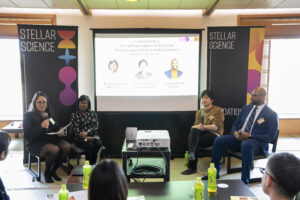 “Open and decentralized science” represents a vision for a next-generation science ecosystem in Japan, advocated by Dr.Takebe as the basis for his founding of SS-F. Compared with the United States, Japan currently has more limited start-up funding for new laboratories and fewer institutional support systems for nurturing principal investigators, which limits the potential for innovation. Dr. Takebe pointed out that the way to unlock this potential in Japan is by supporting small laboratories composed of a few talented early-career researchers to pursue more creative and ambitious research questions, driven by their own interests, while also enabling connections with large laboratories and data and resource platforms not limited to single institutions. Cultivating the SS-F community of inventors and convening them for creative discussions and interactions like this event is a central part of realizing this people-centric vision.
Next, Dr. Graham and Dr. Gunawardane emphasized the importance of collaboration with external organizations. For biotechnology companies, such collaborations provide opportunities to drive the development of breakthrough therapies and to identify seeds that may lead to the next generation of transformative treatments, while for non-profit research institutions, they also represent a pathway to securing long-term and stable research funding.
As science becomes increasingly advanced and complex, there was broad consensus among participants that interdisciplinary team science is essential for advancing research across industry and academia. Building on this shared understanding, the discussion turned to how team science can be cultivated and how creativity can be further enhanced.
One key perspective raised was the importance of training for collaboration and interdisciplinary science. Participants underscored that, in team science, it is essential to train scientists to collaborate with others from the earliest stages of a research career. As an example from a U.S. university, a program was introduced in which each doctoral student is assigned two mentors from different research fields, providing early exposure to diverse research cultures and disciplines.
At the same time, it was also pointed out that the current evaluation system, under which researchers, particularly early-career researchers, are largely evaluated on the number of publications and the impact factors of the journals in which they appear, has posed obstacles to promoting team science. Dr.Prof. Takebe noted that, under his principle of properly recognizing contributions,” all individuals who contributed to a study are listed as authors, which often results in papers with a large number of authors and may not always be viewed favorably by publishers.
Dr. Gunawardane further argued that success in open science should be measured by how widely research outputs are used by the community and how much they advance the field. While measuring and assessing such impacts is not straightforward, the participants raised the need to reconsider existing evaluation systems to move the field towards rewarding team science and open science.
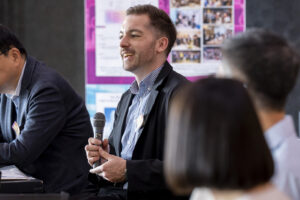 In addition, it is essential to create spaces that foster researchers’ creativity—spaces that bring together people from diverse fields, encourage exchange and collaboration, and cultivate a culture in which every researcher feels respected.
Dr. Graham’s remark succinctly captured the essence of what is required to support the people driving the science of the future: “I think making sure that people feel safe, heard, and protected in their environment, whatever environment they find themselves in, they will be much more likely to be successful, creative, innovative.” As Dr.Takebe also noted, nurturing trust is fundamental to successful collaboration. The session underscored that environments where researchers can feel secure and empowered to pursue challenges are the driving force behind creative innovation.
Continuing to Connect
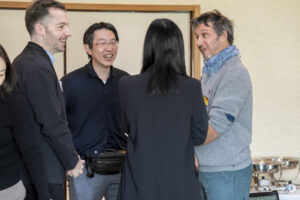
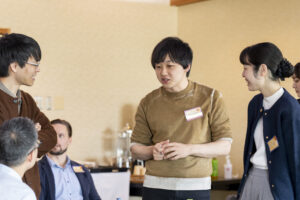
The lively discussions continued well into the networking lunch, where participants engaged in open and informal exchanges on a wide range of topics, including their research, research environments, and future career paths. The energy remained high until the very end, and the event concluded on a collegial note. Many participants left the venue with smiles, expressing both a sense of reluctance to part and anticipation for future reunions.
 Participants shared positive feedback, such as: “The discussions on the challenges of translating stem cell technologies, including iPS cells, into clinical applications were extremely insightful and offered a broad perspective. I was also reminded of the importance of connecting people of diverse nationalities and expertise, and of creating environments that facilitate such connections—insights I hope to apply to my future research and laboratory management.” These reflections underscored the event as a highly fruitful and meaningful gathering.
This event embodied SS-F’s vision of “People-Centric”—science born from people, connected through people, and expanded by people. The community’s continued growth is eagerly anticipated, and we look forward to the next Pioneers Series.
【Writing: Ayaka Nakauchi】
