
Stellar Lab Radio Episode3 Guest:Kyoko Miura
What if there were a mammal that hardly ages and never develops cancer or Alzheimer’s?
That “extraordinary species” is the naked mole-rat. Living cooperatively in large underground colonies, this small creature offers remarkable clues for the future of humanity — not only in terms of healthy longevity, but also in how we might build a more harmonious, conflict-free society.
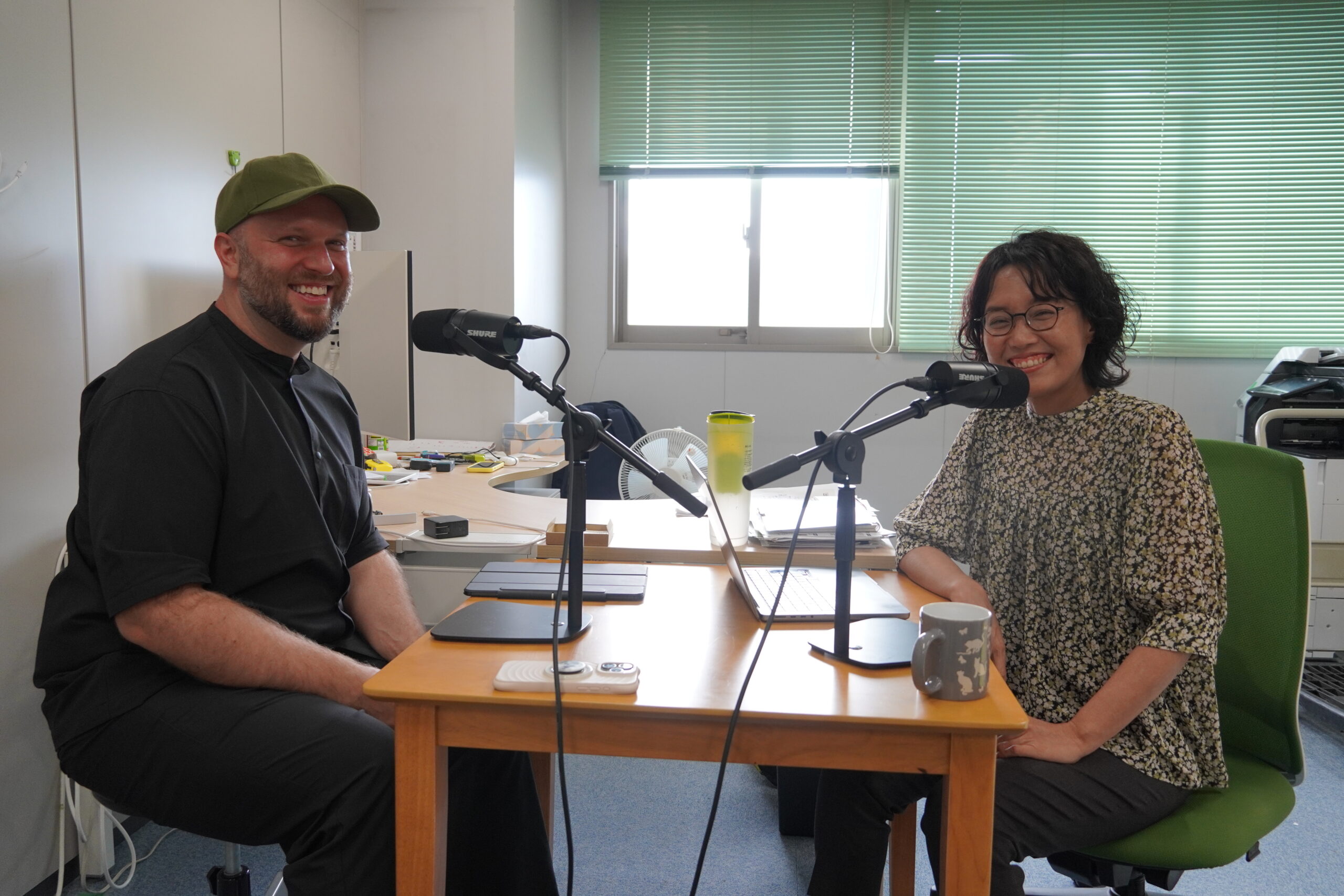
In this episode of Stellar Lab Radio, we welcome Professor Kyoko Miura from Kyushu University’s Graduate School of Medical Sciences, who is exploring the mysteries of aging and coexistence through her pioneering research on naked mole-rats. Stellar Lab Radio is a talk program that sheds light on world-changing research that few people have heard of, featuring leading scientists who reveal the stories behind their breakthroughs and share their vision for the future.
In the first part of this conversation, we discuss new approaches to creating breeding environments for naked mole-rats, a matchmaking strategy used to facilitate reproduction, the biological secrets behind their resistance to aging and cancer, and the mechanisms that sustain their remarkably peaceful society. By studying what may be the most age-resistant creature on Earth, we begin to uncover insights that could reshape not only biological science, but our understanding of human society as well.
From Kumamoto to Kyushu University — Behind the “Great Naked Mole-Rat Migration”
Sean: We’re recording today in Professor Miura’s lab at Kyushu University. You moved here in April, right? And before that, you were at Kumamoto University?
Miura: That’s right.
Sean: But your naked mole-rats—the “Deba-chan,” as you call them—are still back in Kumamoto, aren’t they?
Miura: Yes, they’re still at Kumamoto University.
Sean: I imagine moving them must be quite challenging.
Miura: It’s a major operation.
Sean: I can imagine. How did you prepare for that?
Miura: We’ve been preparing for nearly a year.
Sean: So it takes a long time to build a new environment for them.
Miura: Exactly. At Kyushu University, we have to build the entire breeding facility from the ground up—design, equipment, and everything else. Once all of that is ready, then we can finally move them.
Sean: I see.
Miura: We call it “the great naked mole-rat migration.”
Sean: I love that. And beyond treating the mole-rats as a research subject, caring for them and raising them properly must also be a crucial part of your work.
Miura: Absolutely—it’s essential.
“Housemates But No Romance? The Everyday Trials of Breeding Naked Mole-Rats”
Sean: One thing I’ve really been curious about is how you figured out the breeding methods — how did you learn what works?
Miura: That goes back to when I first started working with naked mole-rats in 2010. I inherited them from Professor Kazuo Okanoya, who is now at Teikyo University and had been working on naked mole-rats before me. He taught me the basics of breeding and caring for them — I learned everything directly from him. But after that, it took about 15 years of trial and error to improve the methods. At first, they hardly reproduced at all, so we kept trying different approaches. Now we’ve finally reached a point where the breeding is going fairly well.
Sean: That’s amazing. So without the optimal environment, it really doesn’t work?
Miura: Exactly.
Sean: So you’ve been experimenting with the methods?
Miura: Yes. Even today, we keep adjusting things bit by bit. It really is a constant process of trial and error.
Sean: In that process, did anything surprise you? Something like — “Oh, this environment works better”?
Miura: Yes. What surprised me most early on was that they didn’t reproduce at all. I assumed that, being rodents like laboratory mice, they would breed fairly easily. But we spent almost a year and a half without a single birth. I was shocked — I thought, Can that even happen? So we kept making small changes and testing ideas. There wasn’t one big solution; it was really about how we care for them day to day and also how we create new colonies. We even use a kind of “matchmaking” process.
Sean: Matchmaking? How does that work?
Miura: We observe their behavior to see if the individuals are compatible. That’s the key.
Sean: Like — “this one and this one might work out together”?
Miura: Exactly. Otherwise they just end up like housemates. With mice, if you pair a male and female, it usually works. But with naked mole-rats, they just become roommates — and never shift into romance mode.
Sean: So no romance — just cohabitation?
Miura: That’s right. You end up with lots of housemates and no babies. That’s why we have to be very careful. And I think things like diet, bedding materials — those also matter a lot.
Sean: I see. About the behavioral cues you mentioned — how do you tell if they’re compatible?
Miura: I’m actually writing a paper on that now, so I can’t give details yet.
Sean: Ah, still confidential — fair enough. It’s fascinating though.
Miura: Let’s just say — it all comes down to compatibility.
Sean: That’s so interesting. The naked mole-rat is such a symbolic species — I’ve really wanted to ask about this.
Miura: They are fascinating indeed.
Sean: Definitely. And if compatibility itself becomes a research question — could you tell us a little more about how your research connects to that?
A Body Resistant to Cancer, Diabetes, and Alzheimer’s: The Naked Mole-Rat as a Model for Healthy Longevity
Miura: Absolutely. Our central theme is that naked mole-rats are a model for healthy longevity. They show remarkable resistance to aging — and also to age-related diseases such as cancer, Alzheimer’s disease, and diabetes. Among mammals, it’s extremely rare. They’re just like us — mammals — and yet they rarely age or develop these diseases. Our research focuses on understanding why they can do that, and what makes them different from humans and mice, who are much more vulnerable to these conditions as we age.
Sean: I see. So in the end, it’s not only about their resistance to aging, but looking at the whole spectrum of life — including social factors like compatibility — as potential research topics as well, correct?
Miura: That’s right. Naked mole-rats are gaining attention as a model animal for healthy longevity, but at the same time, they’re fascinating from a behavioral science perspective. Much like ants or bees, they live in highly social structures. They form colonies of dozens — sometimes up to a hundred individuals — and live together in a dense underground environment, yet maintain a remarkably peaceful society. Understanding what supports that cooperative social system is a very interesting research question. So the compatibility research we talked about earlier is part of that, and recently I’ve been collaborating with Professor Okuyama at the University of Tokyo on social behavior studies, as well as with Professor Kutsukake at Sokendai.
Sean: That’s fascinating. Did your interest begin with aging-resistant animals? How did you land on naked mole-rats in the first place?
Miura: In the beginning, I was actually researching tumors related to iPS cells. Pluripotent stem cells — both iPS and ES cells — can form tumors when they remain undifferentiated. So through that work, I became very interested in cancer biology. When I learned that there was a mammal that doesn’t get cancer, I was stunned — and my curiosity grew even more when I discovered they also don’t develop other age-related diseases like Alzheimer’s, diabetes, or heart disease. If naked mole-rats are mammals and share much of the same physiological systems with us — even about 80% of the same genes — maybe the difference lies in how those genes are used. And if that’s the case, perhaps we can eventually apply those mechanisms to humans. That possibility was what really drove me to start this research.
Around the time I received my PhD, next-generation sequencers were being developed. That was a turning point. Until then, molecular biology could only advance through a few well-known model organisms like humans, mice, or fruit flies whose genomes were understood. But with next-generation sequencing, I realized that genomic research could suddenly expand to countless species on Earth. I wanted to explore that frontier — to study a fascinating organism that could benefit human health.
At first, I even considered studying ancient cedar trees — the Jōmon Sugi — but I thought I might not survive as a postdoc in that field (laughs), so I looked for something else. Eventually I found naked mole-rats — and I felt immediately, this is it. Luckily, Professor Kazuo Okanoya, who I mentioned earlier, happened to be breeding them. I contacted him out of the blue, and he told me to come visit. It turned out he was planning to stop his naked mole-rat research, and after a year of training in his lab, he told me he would pass the animals to me and encouraged me to continue the research.
Sean: That’s incredible — he completely handed it all over to you.
Miura: Yes, he did. I was actually hoping to become a postdoc in his lab, but instead he entrusted the entire colony to me. We moved 30 animals to the corner of Professor HideyukiOkano’s lab at Keio University — he kindly allowed us space to keep them. Thanks to everyone’s support, I was able to launch the research.
Sean: That’s amazing. But that also sounds like a heavy responsibility — as if he said, “I’m counting on you to continue this scientific lineage.”
Miura: Yes, I felt nervous at first. Even after a year of training, it was uncertain whether the new colony would thrive. But thanks to the people around me — like Ms. Arai, who worked with me as a breeder — we somehow managed.
Sean: You went from working with iPS cells and tumor studies… to managing 1,800 mole-rats! That’s quite a shift, isn’t it?
Miura: Actually, I had been working with both cells and mice before, so the transition felt natural. In cancer research we often use mice as model organisms. So in that sense, it wasn’t completely new for me — it was an expansion.
A Conflict-Free Community: The Social Strength of Naked Mole-Rats
Sean: Thank you. We touched earlier on their social behavior, and I’m curious — they’re known to have a very unique form of sociality among mammals. Do you think that connects directly to their resistance to aging?
Miura: That’s something I’ve become increasingly interested in. I suspect that living in cooperative groups — maintaining a social structure — may have played some role in the evolution of their healthy longevity. Maybe not only in a purely evolutionary sense, but perhaps the act of living together benefits them physically or mentally. It could involve physical interactions, or something like social support. I’d like to explore that further in future research.
Sean: That’s fascinating. Their environment and culture are so different from other rodents. If the social factor turns out to be significant, that could be a powerful finding.
Miura: Exactly. Unlike animals that live alone, naked mole-rats have developed a highly cooperative society, and conflict within their colonies is remarkably rare. They live together peacefully, and I imagine the presence of companions reduces stress rather than increases it. They probably receive many benefits that way. It makes me wonder — just like humans have societies where we help each other, could there be something here that physically promotes healthy longevity? I’m still just speculating at this stage, but it’s an intriguing thought.
Sean: Personally, I think there might be something to that.
Miura: I do too, actually. There are even studies showing that loneliness is worse for your health than smoking.
Sean: Very true. And when it comes to their unique social structure — do we know why they developed it? Where did it come from?
Miura: From an evolutionary perspective, it’s said to be linked to their habitat. They live underground in the dry regions of the savanna, searching for sparse sources of food like roots and tubers that are scattered about. To find them, they dig complex tunnels — sometimes three kilometers long. The advantage is that there are very few predators — it’s hard to dig through the soil, and food is scarce, so other species don’t usually invade. It’s peaceful. But the downside is that acquiring food requires enormous effort. So surviving alone and raising offspring would be nearly impossible — which likely led to the evolution of their social behavior.
Sean: I see.
Miura: They are sometimes described as an adaptation to a “poor but peaceful environment.” And it’s believed that during that adaptation process, their ability for healthy longevity may have developed as well. Exploring that link is extremely interesting.
Sean: Hearing that makes me imagine them working really hard to find small bits of food, bringing it back, and sharing it with the colony.
Miura: That’s exactly what they do. They transport food and share it.
Sean: How do they share it? Is there a rule — who gets how much, and when?
Miura: There aren’t clear rules as far as we know. They go out, find food, carry it in their mouths, and run back through the tunnels. There’s a room called the “nest” where they all sleep, and they tend to pile food around that area. That’s where they gather and eat.
Sean: So do they gather like a dinner bell has rung, or do they eat whenever they want?
Miura: When we feed them in captivity, they all come to eat. But the stored food near the nest — they probably access it whenever they’re hungry. Like, “I’m hungry — time for some sweet potato.”
Sean: But no fighting — nobody says, “That’s my sweet potato.”
Miura: Not really. They rarely fight over food.
Sean: That’s remarkable. You would think dependency might cause conflict, but instead the community remains peaceful. Why don’t they fight?
Miura: That’s a mystery — and from a neuroscience perspective, it makes them a very intriguing research subject.
Are We Younger Than the Sazae-san Generation? Rethinking What It Means to Age
Sean: From your current research, I imagine there are many fascinating angles, but is there anything recently that genuinely surprised or moved you — something that made you think, “This is incredible”?
Miura: There are quite a lot, actually — and the fact that there are so many is, in itself, astonishing. What’s becoming clear is that healthy longevity in naked mole-rats isn’t governed by a single mechanism. It’s layered — from DNA and genome repair, to RNA regulation, to protein function, to cellular-level processes. For example, they have systems that efficiently eliminate senescent cells before they can cause trouble. Their DNA repair capacity is remarkably high. At the tissue level, their bodies don’t trigger excessive, harmful inflammation the way ours do. It feels like every possible mechanism has been tweaked to support healthy longevity, and that complexity is truly fascinating.
Sean: That’s amazing. I imagine that aligns with your original vision — connecting biology with human health, and maybe helping redefine it.
Miura: Exactly. That’s why one of our goals now is to pick several of these key mechanisms found in naked mole-rats and try to reproduce them in mice, to see how much of their healthy longevity can be recapitulated. Of course, we can’t re-create the whole system, but even partially replicating it would be meaningful.
Sean: Eventually, do you think this kind of research could help humans live 200 or even 300 years?
Miura: I think it’s possible. Personally, I’m not so focused on just extending lifespan. Extending life alone can bring its own societal and cultural challenges. My hope is to extend healthy lifespan — to help people stay vibrant, active, and disease-free as long as possible. That would make a meaningful difference — medically, socially, and economically.
Sean: Right — so less about “living longer,” more about “living well.”
Miura: Exactly. In aging societies today, the final ten years of life are often spent with declining health, multiple diseases, and reduced quality of life — not only for individuals but also their families. My goal is to develop the science that helps people stay healthy until the very end — what we sometimes call pinpin korori in Japanese — meaning living actively until the moment of death. And as a result, lifespans may naturally extend — possibly to 150 or 200 years.
Sean: It makes me wonder — if humans do live to 200 or 300, wouldn’t that also require a peaceful, cooperative society — like the naked mole-rats?
Miura: That’s an interesting idea. When we imagine lifespans doubling, many people picture an increase in “elderly” age groups. But what if the younger phase also becomes longer? The entire concept of age might shift. Maybe being 100 would be like being middle-aged.
Sean: That’s fascinating.
Miura: For example — do you know the manga Sazae-san? The father in the show, Namihei, is said to be in his mid-50s. But biologically, today’s 70-year-olds may be closer to Namihei’s age in function. That means our concept of age — what it means to be “old” — has already changed. Aging itself is slowing down, and our social perception hasn’t caught up yet.
Sean: That’s incredibly interesting. In naked mole-rat societies, does age change social roles like it does in humans?
Miura: Yes, but in a mild, flexible way. They don’t have rigid divisions like ants or bees. But within the “worker” group, some individuals are more exploratory — digging tunnels, expanding the nests. Others act more like soldiers, protecting the colony when needed. There’s some association with age and body size, but it’s not strict.
Sean: I see. Naked mole-rats can live up to 40 years — and remain healthy almost to the end, right?
Miura: Yes, that’s correct.
Sean: So if they stay healthy, why do they die at all?
Miura: That’s one of the most important, unanswered questions. What we do know is that most deaths are due to accidents, injuries, or opportunistic infections — things that could happen at any age. Importantly, their mortality rate doesn’t increase with age — which is normally a hallmark of aging. In naked mole-rats, that doesn’t happen. So — if a mole-rat avoided all accidents, injuries, and infections — we still don’t know why it would eventually die.
Sean: That’s fascinating.
Miura: We really want to understand that. That’s why we’ve been working with a veterinary pathologist to analyze every mole-rat that dies — trying to identify true causes. But our oldest mole-rat so far is only 23. The real insights may come in 10 or 15 years.
Sean: So this is literally a long-term, lifelong project.
Miura: Yes. Naked mole-rat research requires patience. It’s a long journey.
Sean: And in research environments, they’re protected from predators and accidents. That must be extending their lifespan too, right?
Miura: It might. For example, when I started in 2010, the maximum reported lifespan was about 28 years. Now it’s over 40. We’re not sure how much further it will go — but it may still increase.
Sean: Where did those extra 12 years come from?
Miura: Simply because 12 more years have passed — and the same individual is still alive.
Sean: That’s incredible.
Miura: It is. And from now on, we’ll continue to age with them — watching what happens.
Sean: That’s beautiful — and strangely poetic.
Miura: It is, isn’t it? And maybe that’s part of the story: aging alongside them, with multiple generations in one colony, could itself hold clues to healthy longevity — not only in biology, but in society.
Sean: That’s wonderful.
Miura: There must be something there — we just haven’t discovered it yet.
How Living Together Shapes the Body: Health, Society, and the Future of Longevity
Sean: I feel like your research connects so many different dimensions — health, social behavior, even human-centered questions about society today. Your motivation to extend healthy lifespan really stood out to me earlier, and it makes me wonder: as your research progresses, what kinds of things do you think might become possible? I imagine there are many angles.
Miura: Yes, absolutely. In the end, it’s ideal if both the body and mind can stay healthy and resilient.
Sean: Agreed.
Miura: And I think that means our social systems will also need to evolve. Our bodies — our genetic systems — were shaped by evolution to fit a very different environment from modern society. In many ways, our current social structures aren’t aligned with what our biology expects.
Sean: That’s true.
Miura: So perhaps society itself needs to become more flexible. That’s something I often think about — that maybe our research on naked mole-rats could offer hints for that.
Sean: Over the last 200 years, human life has changed completely — how we work, live, connect, even think. But our biology — our instincts, our emotional systems — haven’t necessarily adapted at the same pace. I wonder how discoveries from your research could help us reconnect those pieces. Do you have any ideas about how we might “evolve” our society?
Miura: One area might be how people connect — how close we allow ourselves to be to one another. That’s very much in line with what SS-F aims to explore. How should people relate? What distance is healthy? Both younger generations and older generations have valuable strengths — how do we create the right balance? I often say things need to be “chōdo ii anbai” — just the right balance. Convenience is valuable, but too much can weaken us socially. The way we connect matters — the quality, not just the quantity. If naked mole-rats can offer hints there, that would be wonderful.
Sean: Especially considering current demographics in Japan — in the next 20 years, a much higher percentage of the population will be over 60. We’ll need to rethink how society is structured. How we connect. How we care for one another.
Miura: Exactly. I think it’s important for younger and older generations to be in constant contact — to mix naturally. That’s become very rare today. In the past, people raising children and those not raising children would still mingle in everyday life. That no longer happens, and that lack of shared experience creates various forms of division. So building systems where different generations naturally mix might be key.
Sean: That’s fascinating. And unlike naked mole-rats, humans actually can redesign society consciously — we have the ability to build new systems using inspiration from nature.
Miura: Exactly. We can change things.
Sean: So when it comes to healthy lifespan — physical health and mental health — what balance do you personally prioritize?
Miura: Fundamentally, I focus on the physical side. But I’m also very interested in how social systems — like those seen in naked mole-rats — may support physical health. I think that connection will become a major theme in the future. And — I also love space, by the way. (laughs)
Protecting Human Health in Space — A New Frontier for Naked Mole-Rat Research
Sean: I also wanted to ask about outer space — I know that’s something you’re really interested in.
Miura: Yes, I love space.
Sean: And you mentioned wanting to take on space as the next challenge. I’d love to hear more — why space, and what do you want to explore?
Miura: When humans move into space, maintaining physical health becomes absolutely critical. Prolonged exposure to microgravity causes major damage — bone loss, muscle atrophy, immune system decline. There’s also radiation damage, which is extremely severe. Naked mole-rats are believed to have strong resistance to radiation, and possibly to bone and muscle deterioration as well. So, I’m fascinated by the idea of studying naked mole-rats in the context of space medicine. It’s partly because I simply love space — but also because I think their biological strengths could hold key insights. When things settle down a little, I’d love to explore that direction more seriously.
Sean: That’s exciting. As different countries begin to focus more on space exploration, I imagine the next frontier will be understanding how humans can live in space — not just reach it. Analyzing the strengths of naked mole-rats seems like a promising approach.
Miura: I think so too. I’d really like to try that. Again — maybe just because I love space! (laughs)
Sean: I’d like to shift directions briefly. We’ve talked a lot about your research — but I’d also love to hear more about you as a researcher. What made you want to pursue science in the first place? What drew you into research — and what keeps you excited about it?
Miura: That’s a good question… the origin story…
Sean: That’s where we’ll end the first half of our conversation with Professor Miura. Personally, I was fascinated by how she approaches the naked mole-rat not only as a model of physical resilience — but also as a source of insight into social structures and human coexistence.
In the second half, we’ll explore why she chose to become a researcher, the moment that sparked her journey into science, and the passion that drives her work today. We hope you’ll join us.
Stellar Lab Radio – exploring world-changing research that nobody knows about yet.
